
News and Opinions
From compliance to learning: Reframing M&E as MEL
Liezel de Waal, CO-FOUNDER AND SENIOR EVALUATOR, M&ESURE RESEARCH AND EVALUATION
In the development world, most organisations use Monitoring and Evaluation (M&E) systems because donors require them.
These systems often serve a narrow purpose: showing accountability and providing evidence for fundraising. While important, they rarely reflect an organisation's own priorities. They capture only part of the story and, too often, feel like a compliance exercise, a "grudge purchase" made to unlock the next tranche of funding.
 The problem is not with any single actor. It lies in a system that has not placed learning at the centre. When M&E is treated purely as compliance, its power to inform, adapt, and strengthen programmes is lost. Yet if we shift the focus to learning first, something powerful happens. Accountability and compliance follow naturally, and data becomes a tool for improvement, not just reporting. This is the promise of Monitoring, Evaluation and Learning (MEL): turning evidence into insight, and insight into action.
Building Blocks of MEL
To move towards MEL, we need to unpack the logic of our interventions.
Four steps stand out:
- Start with a Theory of Change (ToC): Lay out how activities are expected to lead to outcomes. A good ToC tells us not only what we do, but why it should work for donors, partners, and communities alike.
- Create a Logic Model: From the ToC, identify what can realistically be measured. Build indicators that show progress and anchor ambitions in evidence.
- Develop a MEL Plan: Expand the Logic Model into a plan that clarifies what data will be collected, by whom, and when. It should also spell out how information will be used and shared across the organisation.
- Define reporting pathways: Decide what is reported, to whom, and through which channels, so that communication is clear and consistent.
The MEL Cycle
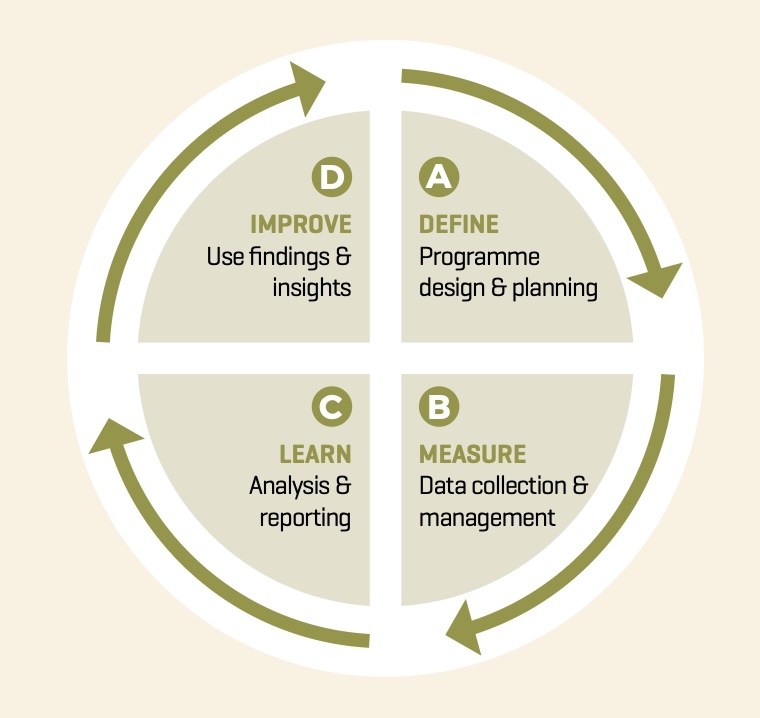 Beyond these tools lies the MEL cycle; the ongoing process of embedding monitoring, evaluation, and learning into everyday work. A strong MEL cycle reflects what is really happening in programmes and ties directly into broader organisational planning and decision-making.
Adding learning questions makes the cycle more powerful. These questions open up space for reflection, creating feedback loops that strengthen practice. At the programme level, they might ask why attendance is low or whether activities are delivered effectively. At the strategic level, they help leaders decide whether to expand, adapt, or redirect programmes.
Why It Matters
This approach does not happen overnight. Building a MEL system takes time, investment, and patience. But the rewards are significant. Participants experience more relevant, higher-quality programmes. Donors can invest in initiatives that deliver real, proven impact. And organisations reclaim ownership of their learning, using data to shape strategy and strengthen delivery rather than simply reporting upwards.
At its best, MEL transforms M&E from a burden into a driver of excellence. It ensures that accountability and learning are not competing demands, but two sides of the same coin both serving the ultimate goal of creating meaningful, lasting impact.
Liezel de Waal is co-founder and senior evaluator at M&ESURE Research and Evaluation, a consultancy based in Cape Town, providing M&E-related services for more than 15 years to a range of clients from grassroots non-profit organisations, academic institutions to global non-profits and donor organisations. M&ESURE recently launched its capacity development and data systems development arm, Fundamental. Find out more here: www.fundamentaltools.co.za
Source: 2025 Inyathelo Annual Report