
News and Opinions
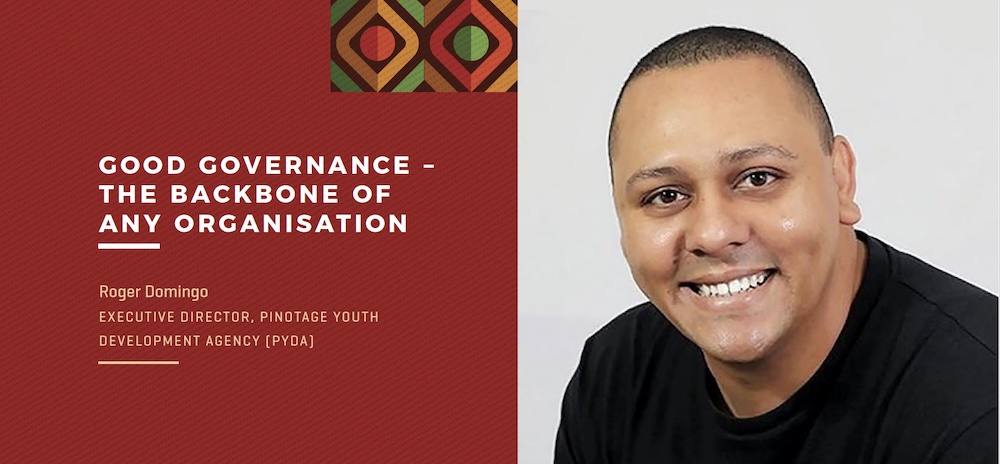
Good Governance – The Backbone of Any Organisation
Roger Domingo, Executive Director, Pinotage Youth Development Agency (PYDA)
For many organisations, governance is about a few meetings a year, compliance such as statutory reporting, and annual audits. While these are essential, PYDA has embraced a deeper understanding. Governance is not simply a checkbox exercise; it is a vital part of the organisation’s character that shapes how it builds credibility, inspires confidence, and ensures accountability. This has allowed us to balance our commitment to the mission with the realities of financial and operational risk. Through improved oversight and transparent decision-making, we have built resilience, even when navigating difficult financial periods.
A key moment of learning and leadership came with our board renewal in 2024 and 2025. The election of a new Chair and the addition of directors with diverse expertise and lived experience brought both continuity and innovation. Sector specialists in law, governance, education and people development have broadened the board’s capacity to guide strategy. This intentional diversity actively strengthens PYDA’s governance by ensuring decisions are grounded in multiple perspectives and by reinforcing its commitment to inclusivity and shared leadership.
 In 2024 and 2025 we worked with Inyathelo to strengthen our board’s functioning through a process that began with a board skills audit and continued with a series of virtual and in-person sessions. These covered the essentials of good governance, including clarity of roles and responsibilities, financial oversight, compliance, and ethical leadership. We also gave attention to areas such as resource mobilisation, risk, and diversity. The process helped us to reflect honestly on where we are, identify areas for growth, and build greater confidence and cohesion as a board committed to ensuring that governance actively supports PYDA’s mission and long-term sustainability.
The skills audit and training sessions encouraged us to ask honest questions about our effectiveness, our blind spots, and our ability to adapt to a changing context. This process was not about theory; it translated directly into how we prepare for board meetings, engage with financial information, and approach strategy.
A key lesson that emerged this year is that strong governance is inseparable from ethical leadership. Board members must work within a framework that guides principled action at all times. This means ensuring that policies, processes, and practices reflect fairness, accountability, and respect for stakeholders. This naturally flows throughout the organisation.
Our beneficiaries and the community experience it in the reliability and integrity of programme delivery. Our funding partners recognise it in transparent reporting and clear communication. Staff experience it in a culture where leadership models the values it asks others to uphold. In this way, governance is not only a boardroom exercise but a daily practice that shapes PYDA’s culture.

Our experience has also shown us that governance is not only inward-looking but has an outward dimension. By strengthening our own systems, we also contribute to a broader culture of accountability in the non-profit sector. Other organisations look to PYDA as an example, and we see part of our role as sharing what we are learning so that the collective impact of the sector can be strengthened. We continue to reflect on our governance practices and the broader role PYDA plays in the sector. We remain committed to being a learning organisation and embrace good governance as a pathway to growth.
“A key lesson that emerged this year is that strong governance is inseparable from ethical leadership.”