
News and Opinions
Navigating Global Funding Challenges: A CPUT Perspective
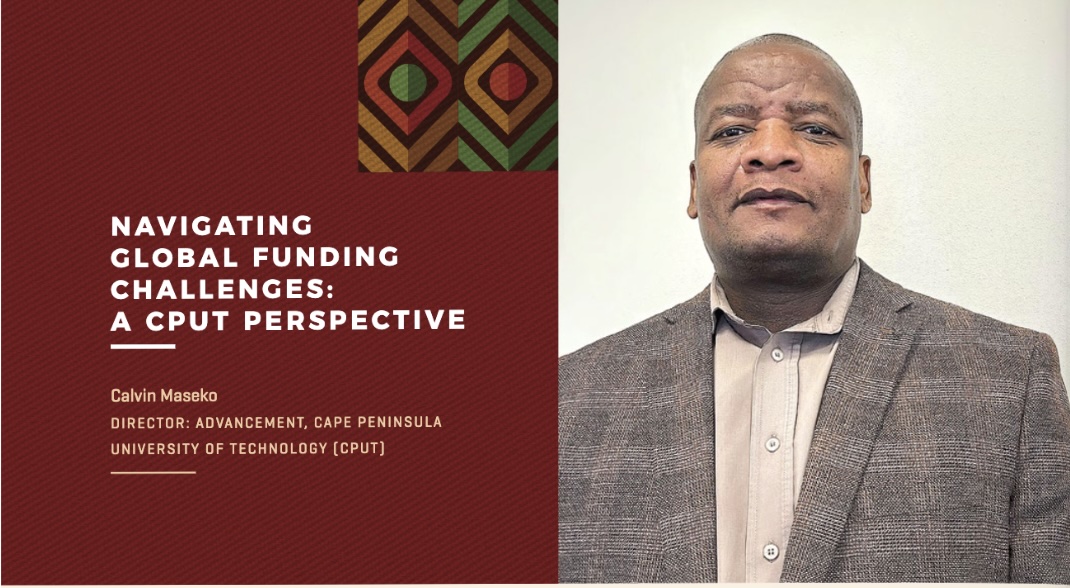
Calvin Maseko, Director: Advancement, Cape Peninsula University Of Technology (CPUT)
Globally, higher education is under pressure. Economic uncertainty, geopolitical instability, shifting donor priorities, and the aftershocks of COVID-19 have forced institutions to reassess how they remain financially sustainable while delivering on their academic and social mandates.
In South Africa, these pressures are amplified by local challenges such as shrinking government subsidies, rising student debt, and a heavily burdened National Student Financial Aid Scheme (NSFAS). Demand for access continues to grow. At the Cape Peninsula University of Technology (CPUT), we received over 500,000 applications for 2025, the second highest in the country, yet could only admit around 6,000 new students.
As the gap between resources and demand widens, institutions must find innovative, resilient strategies to stay relevant and responsive. At CPUT, this imperative has become a defining feature of our advancement journey.
Funding Realities: Global Volatility, Local Strain
Over the past decade, international donor funding has become increasingly unpredictable, often being redirected to urgent local crises or shifting global priorities. For universities in the Global South, this has translated into reduced access to traditional funding partners at a time when internal demands are rising. In South Africa, universities face additional constraints. Government subsidies remain insufficient, and NSFAS is under significant strain. At CPUT, many students are affected, including those who applied during the TVET cycle, students whose funding was confirmed after the registration upload cut-off date, those with pending approved appeals, and 236 students impacted by NSFAS exceptions. Meanwhile, over R1 billion in student debt is carried forward annually.
Despite these challenges, public demand for tertiary education continues to soar. While South Africa’s improving matric pass rate signals growing opportunity, it also intensifies the challenge: how can we sustainably fund a rapidly expanding student population?
Strategic Advancement: Turning Challenge into Opportunity
CPUT has responded with intent. The Advancement Office plays a pivotal role in mobilising third-stream income—funding from non-government, non-tuition sources—to meet urgent institutional needs. Our approach is grounded in strategic alignment with institutional and national goals, and a firm focus on measurable impact that demonstrates value to funders.
In 2023, the Advancement Office secured over R132 million in donor funding. Most of this directly supported students through bursaries, hardship grants, and academic development initiatives. One flagship effort is our Work Integrated Learning (WIL) programme, which disburses approximately R1.7 million monthly, enabling students to complete mandatory workplace placements critical for graduation. This work is not just about raising funds, it is about unlocking potential and ensuring that financial hardship does not derail a student’s future.
A Culture of Accountability and Trust
A key factor in our fundraising success is institutional credibility. Over the past five years, CPUT has achieved five consecutive clean audits, with a sixth on the horizon. This record reflects more than compliance; it demonstrates a culture of transparency, efficiency, and integrity. In today’s funding environment, donors are not only interested in where their money goes, they care deeply about how it is managed. Clean audits build donor confidence. They show that CPUT is a reliable partner, capable of executing projects with accountability and delivering measurable outcomes. As financial pressures intensify, trust becomes currency, and CPUT has invested in earning and keeping it.
Innovation Rooted in Relationships
Innovation at CPUT is not about flashy tech or complex platforms. It is built on human relationships, trust, and responsiveness. We focus on listening carefully to donor interests, aligning funding proposals with real institutional needs, and ensuring follow-through. We prioritise personal engagement, clarity in reporting, and shared values. Many of these partnerships have been cultivated over years of consistent, value-driven engagement.
CPUT also ranks among the most efficient fundraising institutions in the country. According to Inyathelo’s Annual Survey of Philanthropy in Higher Education (ASPIHE), we spend just 4 cents for every rand raised. For every R1 invested in advancement, we generate R32 in income, a remarkable return that highlights the value of professional, well-managed advancement.
 Impact in Action
The real impact of our work is seen in our students. Every year, over 7,000 students graduate from CPUT many having overcome immense financial challenges. The Advancement Office often provides the bridge that helps a student register, write exams, or receive their certificate, ultimately changing the trajectory of their life.
Our work also drives transformation. In 2005, women made up 51% of the student body. Today, they represent 62%, and more than 65% of fundraising beneficiaries are women. Our funding also supports disability inclusion, and academic success centres, underscoring our commitment to a holistic student experience.
Looking Ahead: A Strategic Imperative
South Africa’s post-school education and training (PSET) sector cannot continue to rely predominantly on first- and second-stream income. The future of higher education lies in growing third-stream income and embedding advancement into institutional strategy.
Inyathelo has played a key role in enabling this shift, supporting universities through benchmarking, capacity-building, and advocacy. But more is needed. Institutions must now work collectively with government, civil society, and the philanthropic sector to secure a sustainable, inclusive, and globally competitive system.
Conclusion: A Call to Collaboration
The funding challenges we face are real, but not insurmountable. CPUT’s journey proves that with strategic leadership, financial integrity, and purpose- driven partnerships, universities can not only survive, but thrive.
To our current and future partners: your support helps students succeed, researchers innovate, and institutions deliver on their promise. We invite you to continue walking with us towards a future where every deserving student has the opportunity to learn, grow, and lead.
This article was first published in Inyathelo's 2025 Annual Report